Understanding Rope Strength: Breaking Strength and Working Load
Published by Chris Riley in Nautical Knots Last updated on July 12, 2022
Rope strength is a misunderstood metric. One boater will talk about tensile strength, while the other will talk about working load. Both of these are important measurements, and it’s worth learning how to measure and understand them. Each of these measurements has different uses, and here we’re going to give a brief overview of what’s what. Here’s all you need to know about rope strength.
How Do You Measure Rope Strength?
Each type of line, natural fiber, synthetic and wire rope, have different breaking strengths and safe working loads. Natural breaking strength of manila line is the standard against which other lines are compared. Synthetic lines have been assigned “comparison factors” against which they are compared to manila line. The basic breaking strength factor for manila line is found by multiplying the square of the circumference of the line by 900 lbs.
(900 lbs. X circumference 2 = breaking strength)
When you purchase line you will buy it by its diameter. However, for purposes of the USCG license exams, all lines must be measured by circumference. To convert use the following formula.
Circumference = p PI (3.14) X diameter
As an example, if you had a piece of ½” manila line and wanted to find the breaking strength, you would first calculate the circumference. (.5 X 3.14 = 1.57) Then using the formula above:
1.57 2 X 900 = 2,218 pounds of breaking strength
To calculate the breaking strength of synthetic lines you need to add one more factor. As mentioned above, a comparison factor has been developed to compare the breaking strength of synthetics over manila. Since synthetics are stronger than manila an additional multiplication step is added to the formula above.
(comparison factor X 900 lbs. X circumference 2 = breaking strength)
Following is a comparison factor chart for synthetic lines.
|
Line Material |
Comparison Factor (greater than manila) |
| Nylon | 2.5 |
| Dacron | 2.0 |
| Polypropylene | 1.4 |
Using the example above, letÂ’s find the breaking strength of a piece of ½” nylon line. First, convert the diameter to the circumference as we did above and then write the formula including the extra comparison factor step.
2.5 X 1.57 2 X 900 = 5, 546 pounds of breaking strength
Knots and splices will reduce the breaking strength of a line by as much as 50 to 60 percent. The weakest point in the line is the knot or slice. However, a splice is stronger than a knot.
Just being able to calculate breaking strength doesn’t give one a safety margin. The breaking strength formula was developed on the average breaking strength of a new line under laboratory conditions. Without straining the line until it parts, you don’t know if that particular piece of line was above average or below average. For more information, we have discussed the safe working load of ropes made of different materials in this article here.
The Difference Between Tensile Strength and Working Load
It’s very important to understand the fundamental differences between the tensile strength of a rope, and a rope’s working load. Both terms refer to rope strength but they’re not the same measurement.
Tensile Strength
A rope’s tensile strength is the measure of a brand-new rope’s breaking point tested under strict laboratory-controlled conditions. These tests are done by incrementally increasing the load that a rope is expected to carry, until the rope breaks. Rather than adding weight to a line, the test is performed by wrapping the rope around two capstans that slowly turn the rope, adding increasing tension until the rope fails. This test will be repeated on numerous ropes, and an average will be taken. Note that all of these tests will use the ASTM test method D-6268.
The average number will be quoted as the rope’s tensile strength. However, a manufacturer may also test a rope’s minimum tensile strength. This number is often used instead. A rope’s minimum tensile strength is calculated in the same way, but it takes the average strength rating and reduces it by 20%.
Working Load
A rope’s working load is a different measurement altogether. It’s determined by taking the tensile strength rating and dividing it accordingly, making a figure that’s more in-line with an appropriate maximum load, taking factors such as construction, weave, and rope longevity into the mix as well. A large number of variables will determine the maximum working load of a rope, including the age and condition of the rope too. It’s a complicated equation (as demonstrated above) and if math isn’t your strong point, it’s best left to professionals.
However, if you want to make an educated guess at the recommended working load of a rope, it usually falls between 15% and 25% of the line’s tensile strength rating. It’s a lot lower than you’d think. There are some exceptions, and different construction methods yield different results. For example, a Nylon rope braided with certain fibers may have a stronger working load than a rope twisted out of natural fibers.
For safety purposes, always refer to the information issued by your rope’s manufacturer, and pay close attention to the working load and don’t exceed it. Safety first! Always.
Knots, Splices and More: Other Considerations
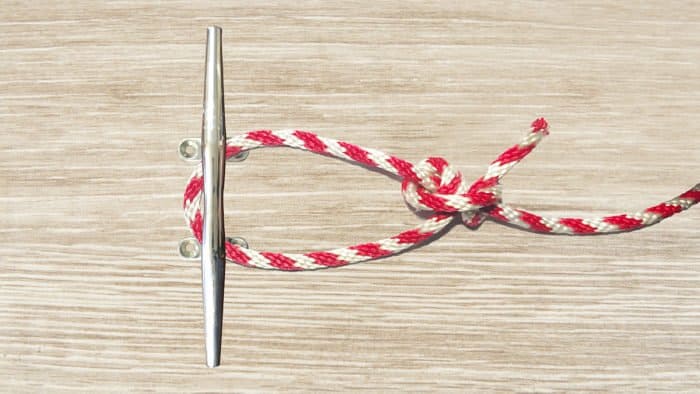
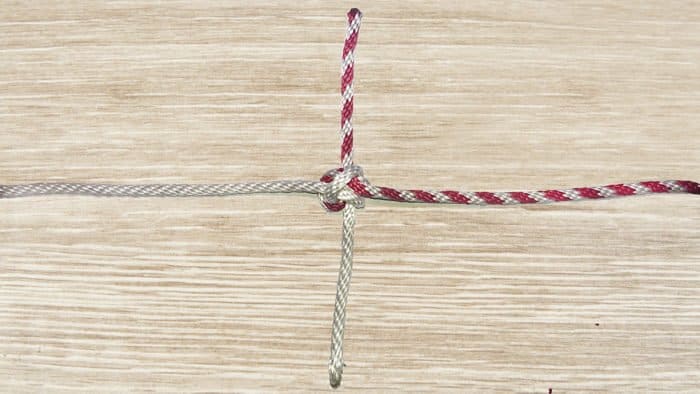
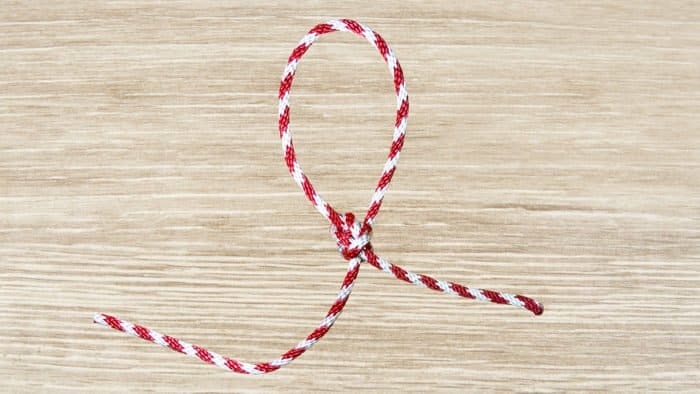
If you’re a regular sailor, climber, or arborist, or just have a keen interest in knot-tying, be warned! Every knot that you tie will reduce your rope’s overall tensile strength. Some knots aren’t particularly damaging, while others can be devastating. A good rule of thumb is to accept the fact that a tied knot will reduce your rope’s tensile strength by around 50%. That’s an extreme figure, sure, but when it comes to hauling critical loads, why take chances?
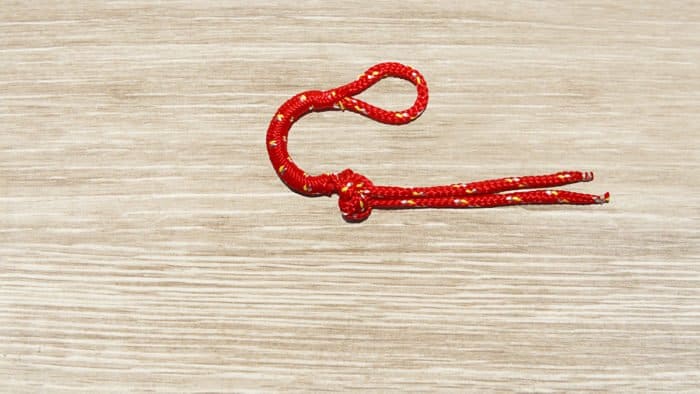
Knots are unavoidable: they’re useful, practical, and strong. Splices are the same. They both degrade a rope’s strength. They do this because a slight distortion of a rope will cause certain parts of the rope (namely the outer strands) to carry more weight than others (the inner strand). In some cases, the outer strands end up carrying all the weight while the inner strands carry none of it! This isn’t ideal, as you can imagine.
Some knots cause certain fibers to become compressed, and others stretched. When combined together, all of these issues can have a substantial effect on a rope’s ability to carry loads.
Naturally, it’s not always as drastic as strength loss of 50% or more. Some knots aren’t that damaging, some loads aren’t significant enough to cause stress, and some rope materials, such as polypropylene, Dyneema, and other modern fibers, are more resilient than others. Just keep in mind that any knots or splices will reduce your rope’s operations life span. And that’s before we talk about other factors such as the weather or your rope care regime…

Categories: Nautical Knots








5 Comments
Larry on June 27, 2020
Thank you very much for your information, one of the few times I actually got an answer right away no running me in circles or trying to sell me something.
Bud Hippisley on March 15, 2021
If “Working Load” is generally taken to be some small percentage (20%, say) of a rope’s “Tensile Strength”, and if knots (for example) reduce a rope’s Tensile Strength to, say, 50% of its manufacturer specification, does the user take 20% of the original manufacturer’s Tensile Strength to obtain a safe Working Load or does the user first reduce the “in use” Tensile Strength by 50% and THEN take 20% of that reduced figure to obtain the safe Working Load. In other words, does the imprecise concept of Working Load include the effects of knots? From your wording about starting with “the tensile strength RATING” suggest Working Load includes possible reductions from Tensile Strength caused by knots.
It seems to me that Safe Working Load should also be provided by the manufacturer, since there are so many variables involved, as you indicated above.
PHILLIP BREWER on June 23, 2021
My question is, how do you determine a safe working load level for docking line? I have a 36ft trawler with lots of windage and would like to get a reliable answer before it’s time to buy new lines.
Adrian Bower on August 1, 2021
Very useful site, with useful information clearly communicated.
I have a question. Countless times, including on this site, I have seen references to knot-tying reducing a rope’s strength by 30-60%. I have recent experience of mooring a 26 metre long flat-bottomed steel boat on the tidal section of the River Medway in South-East England. The river bed is thick mud with a pronounced slope from the side towards the centre of the river. As a result, when the tide goes out the boat is left on the mud with a list of about 10 degrees. This puts a very great strain on the mooring lines as the boat attempts to slide away. In dealing with this situation I have snapped several polypropylene ropes of breaking strain 28 tonnes. These typically had bowline knots tied at the boat end and several round turns with two half hitches on the shore mooring post. Every such rope failure has occurred at least half a metre or so away from any knot. Why do the failures not always occur at the knot itself if that truly is the weak spot? Any constructive comments gratefully received.
Kevin on August 4, 2021
26m is about 85 feet, not a small boat, so the tidal forces will be great. I am assuming you are using 3-strand laid-rope mooring lines consisting of strands, yarns, and fibres (in order from large to small) and not braided lines.
My guess is that the middle section of your mooring line — to be specific, the section between the bowline knots and the round turn & 2 half hitches ashore — is being worn & abraded by chafing against the pier edge in some way, breaking some outer fibres and creating a weak spot mid-section. Under the great tidal loads,these broken fibres shift their load to unbroken fibres, breaking them, and causing the entire yarn to fail. Progressively a strand fails, and then the mooring line fails from this point.
If my guess is correct, you need to wrap your mooring lines in ‘chafe protection’ made out of scraps of leather or fabric, and secured with twine. These will be sacrificed by the chafing instead of the mooring line that they are wrapped around. Anyway, food for thought.