How to Protect Your Boat From Lightning
Published by Ian Fortey in Boats Last updated on September 26, 2022
Of all the dangers you can face at sea, lightning is one that almost no boater considers. Lightning is not a threat in the eyes of most people. It’s considered rare and unusual. You need to get that thought out of your head as a boat owner. Lightning strikes are far more common than you might think.
They key to staying safe from lightning at sea is preparation. You need to use a little help gleaned from 19th century scientist Michael Faraday. He can keep you safe from the total destruction of your electrical systems and a potential fire.
How Common Are Lightning Strikes on Boats?
According to the insurance provider BoatUS, the statistics are very unexpected. Around one in 1000 boats get hit by lightning every year. If there are about 12 million registered boats in America. Knowing that allows the numbers to become a little more clear. That’s 12,000 boats every year getting hit by lightning. One in 1,000 odds are not very high at all.
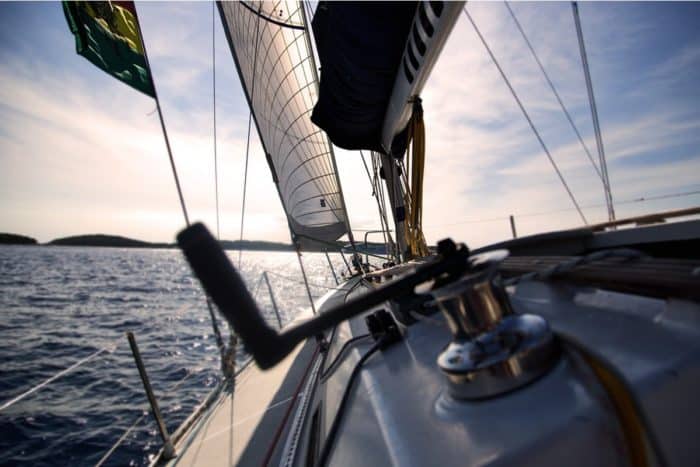
It should come as no surprise that taller boats are more at risk. This is for the same reason you see lightning rods on tall buildings. Lightning wants to get to the ground as fast as it can. It is attracted to conductive materials. The closer those materials are to the source of lightning, the more at risk they are. So anything tall and metal is at the greatest risk. The top of the mast on a sailboat is, in effect, a lightning rod at sea. If a sailboat and a jon boat are side by side on the water, the lightning will hit the sailboat every single time.
Likewise, the bigger the target, the more likely lightning is to hit it. Swap out the sailboat in our example with a yacht. The jon boat is still much safer. Bigger boats have more conductive materials on them. They have their own electrical equipment, which creates an electrical field. More metal parts will attract lightning. And simply having more area exposed makes it more attractive to a stray bolt from the sky.
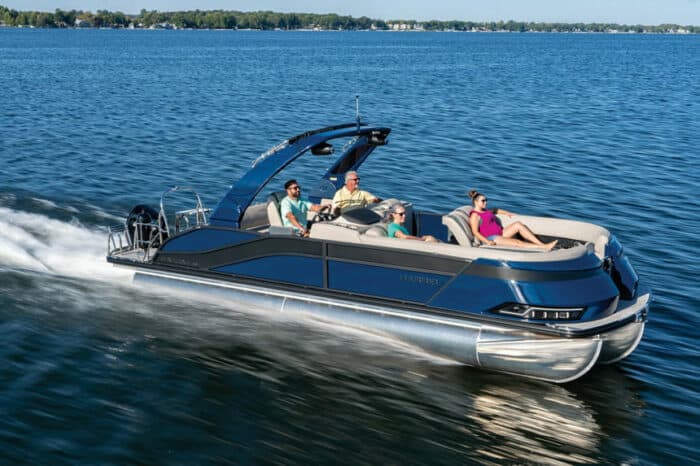
It’s also worth noting that a multi-hulled boat is at greater risk as well. BoatUS stats show a multi-hulled boat is twice as likely to suffer lightning damage. On the upside, this doesn’t hold true for pontoon boats. In fact, they have statistically fewer instances of damage than other boats. So if you’re really worried about lightning, maybe give a pontoon boat a second glance.
- By the numbers, you want to have a bass boat, a pontoon boat, or a runabout. In 2012 and 13, insurance policy claims for lightning strikes on those boats were the lowest. They had a 0.1 chance in 1,000 of a direct lightning strike. That’s about as impressive as it can get.
- Averaged across all boats, the rate of lightning strikes was 0.9 in 1000. We’ve rounded that up to 1 in 1,000. Not trying to make things look worse than they are, but it’s just easier to say it that way. The point is mostly the same.
- A trawler or a motoryacht have a 1.5 in 1000 chance of being hit by lightning.
- A monohull sailboat will bump your odds of being struck significantly. At this point they are 3.8 out of 1000. More than double a trawler, nearly 4 times the average, and nearly 40 times what a bass boat is facing.
- A multihull sailboat has a 6.9 chance in 1,000 of being hit by lightning strikes. That’s about a 1 in 144 chance. You need a lighting protection system of some kind to avoid this. It won’t prevent lightning strikes, but it can prevent damage.
Why Are Multi-Hull Boats More at Risk?
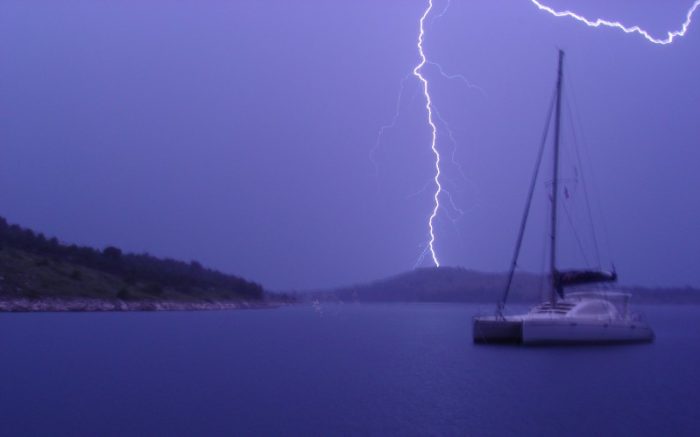
Why is a multi-hull sailboat a danger when a pontoon boat is not? That’s a good question and there is not a good answer. As frustrating as that may be, not enough research has been done. So it’s not easy to explain why a multihull sailboat is so much more at risk than other boats. Since pontoon boats are actually below average, the reason is not immediately apparent. That doesn’t change the fact that statistics bear this out, however. If you have a multihull sailboat, it is at the greatest risk of lightning strikes. That means you’ll want to be a little more cautious than you otherwise would be.
How Does Boat Size Affect Lightning Strikes?
It’s not just the kind of boat you have that can attract lightning. As we said before, size is a factor. Smaller boats offer a smaller conductive path. They offer less chance for lightning to reach ground. Because of that, they are less likely to suffer a lightning strike.
If your boat is fifteen feet or less then you can rest a little easier. Statistically speaking, it’s not likely to be hit by lightning at all. It’s not impossible, but the numbers are not even charted, really. You have a 0 in 1,000 chance. That could mean you still have a 1 in 10,000 chance, so don’t think you’re fully immune.
At 16 feet to 25 feet your numbers increase. There’s a 0.2 in 1,000 chance of any boat at those sizes being struck.
There’s a significant increase above 26 feet. From there up to 39 feet your odds are 2.1 in 1,000. A boat of that size will have a lot more conductive material present. It’s also going to have more electronics on board and you need to worry about that. Lightning strikes and electronics do not mix at all.
Finally, a boat over 40 feet have a 6 in 1000 odds of being struck by lightning.
The mast of a sailboat is hands down the most attractive part of a boat for lightning. If your mast top goes from 35 feet to 45 feet, you just increased the odds of a strike threefold.
Where Is a Boat Most at Risk from Lightning?
Weather can be a very fickle thing. Depending on where you are in the country you may endure lightning storms all the time. Other spots almost never see electrical storms. So it stands to reason not every part of the country is as potentially dangerous as others.
The frequency of lightning flashes across the country follows a fairly reliable path. Nowhere is “safe” from lightning, but there are high concentrations and low concentrations. In fact, you can nearly bisect the country in a diagonal. The northwest United States suffers the least amount of lightning strikes. So up the Pacific Coast into Washington. This is where you will find the lowest frequency of lightning strikes.
You can draw an arrow from that point all the way down to the southeast tip of Florida. Southern Florida has the highest frequency of lightning strikes. Florida is the number one state for lightning damage to boats. Let’s take a look at the list for the top 7 claims locations.
- Florida
- Mississippi
- Maryland
- Louisiana
- Alabama
- South Carolina
- North Carolina
Only one state there isn’t down towards the south-east part of the state. Maryland comes in tied with Mississippi thanks to its high density of sailboats. Something to keep in mind. Even when something seems safe, it doesn’t necessarily mean that it is.
Claims for lightning damage along the Pacific Coast happen rarely. The frequency is around 1 in 10,000. Given how low that is, it should give you pause when you think of the Atlantic Coast. All of the numbers we’re presenting are averages. That means there are a lot of west coast boats that are never being struck. Therefore, there are more east coast boats getting struck by lightning to balance things out. Keep this in mind if you boat anywhere along the Atlantic.
The Pacific Ocean is colder. That means lightning occurs less frequently on that coast. The Atlantic Ocean is much more fertile ground for storms.
What Can a Lightning Strike Do to a Boat?
Now that you know the odds of a lightning strike, what next? How bad could a lightning strike be? Well, it can get pretty ugly. A mild lightning strike will render any fixed electronics useless. Radio, lighting, GPS, bilge pump, engines, you name it. Generators will likely be fried in most cases. It’s not unheard of for a DC solenoid to literally melt.
It’s possible your engine will still run after a lightning strike. But this is like a deer still running after it gets hit by a car. It can happen, but it’s not pretty. It also may not run for long. Expect frequent misfires if it’s still operational. Also, a lot of smoke. Your RPMs are going to drop significantly. Fire risk will greatly increase. The chances of it failing anytime thereafter are very high.
Other systems may continue to function but not in the intended way. We’ve heard of bow thrusters that will continue to run. The problem is you can’t turn them off and they may only run hard to port or starboard. Changing direction is no longer an option.
Suffice it to say lightning can utterly ruin your electronics. More than that, it can wreak havoc with your boat’s body. Most of the metal and writing in a boat is designed with a certain charge in mind. The average lightning bolt is 300,000 million volts and 30,000 amps. It has a negative charge and is DC current. Think of what kind of battery your boat runs on. Is it 12 volt? Maybe 24? No matter what it runs on, it’s not meant to handle lightning level power.
When lightning hits your boat, it’s going to follow the path of least resistance. Unfortunately, lightning can also make use of something called electromagnetic induction. That means if you have two wires near each other, the electrical charge can jump from one to another. Even if the second wire is not touching the first through which the current is flowing. Just being close enough to it allows the power to arc and continue on its path. Your boat is going to be small enough that the lightning is able to continue on a path. It will travel through wires and across metal fittings and fixtures.
Much of the wiring in your boat is likely to be melted completely by lightning. The power flow can actually blow a hole right through your hull. It’s also possible that it will burn the fiberglass around metal fittings. That can create holes and cracks and cause a boat to sink.
Boats on the water typically suffer less damage than those on trailers or stored out of water. On dry land, the electricity will follow a path down to whatever is holding the boat up. On some boats you can even see the scorched path and burn marks along the hull. In the water, the power dissipates more evenly. It will cause less destruction as it reaches ground. In this case, of course, ground is actually water. Lightning protection systems are therefore important in preventing this.
The Cost of Lightning Strikes
So what does all that damage do to a boat? More than 75% of all lightning strike claims are for less than 30% of the insured value. Of those damage claims, the vast majority of them are claiming electronics damage. That’s why, if you see a storm coming, it’s good to unplug those electronics that you can.
All of this being said, you need to keep things in perspective. You already know the odds on even getting hit by lightning in the first place. Suffering severe damage is still a rarity even when lightning strikes do occur. But the fact is it can happen, so you should be prepared. That’s where Michael Faraday and his Faraday Cage.
What is a Faraday Cage?
Michael Faraday created what is the basis for a modern lightning protection system. Lightning strikes can’t be prevented. They can be redirected, though. Faraday was convinced he could make a cage of conductive materials. The outside of the cage would redirect the electrical charge. This, in turn, would protect whatever was in the cage. You may have seen these before in YouTube videos.
The idea is to have this cage of conductive materials around a person or thing. All the metal is bonded together and carries the same electrical potential. Lightning follows the cage to the ground because it’s the path of least resistance. It’s like a bundle of lightning rods fused together. The electrical current can easily travel from the sky to the ground along it.
Obviously you’re not putting a literal cage around your boat to protect it from lightning. However, the same principles are used to protect your boat.
What’s the Best Lightning Protection System for a Boat?
In order to protect your boat from lightning strikes you need a way to redirect those strikes. Your cage is not a literal one but it does require certain conductive materials. You’ll need a marine electrician’s help here. They can put together the best protection system for your particular vessel.
In general, it works like this. Heavy conductors are used to create a cage by bonding all of your boat’s metal components. This starts at the top of the mast and must include all of the major components we have mentioned. Outriggers, railings, arches make a good framework. The AC compressor, engines, stove and other electronics need to be included as well.
A low resistance wire can connect all of these components and offer a path for the lightning to travel. The current will travel to ground, or in this case water, along the path. It can exit the boat through the propeller shaft or keel bolts. Ideally, though, you want a separate system in place. At least one square foot in diameter external ground plate is ideal. The electrical current can be routed to the ground plate and avoid damage to the rest of the boat.
Your engines should be bonded. This helps you avoid something called side flashes.
What is Thompson’s Lightning Protection System?
The National Fire Protection Association helped devise a system. Along with the American Boat and Yacht Council, they created this method. It was devised by Electrical engineer Ewan Thompson. He developed it as the best way to protect a boat from lightning.
- Start with lightning rods. A single rod protects in a cone of about 45-degrees. You want more than that, of course. Several lightning rods set up around a boat provide maximum lightning protection. Thompson found that the best lightning rod is a ½ inch in diameter with a rounded top. Located at the bow, the stern, and above the highest points can help create the basis of your cage.
- The rods need to be connected with heavy two-gauge wire. The wire needs to travel the easiest path to the water’s surface. If there are bends, they need to be long, sweeping ones. Remember, the current could potentially leap from one wire to another. This will happen if they are too close together. Run them outboard and keep them two feet away from any other wires. This is especially important if they are on parallel paths. Any closer and you risk electromagnetic induction. Then all your hard work will be for nothing.
If there is a point where your lighting wires cross normal wires, make it a right angle. Induction has the least chance of happening at right angles. It keeps the contact to the bare minimum.
- Rails and aluminum supports for a hardtop can become part of the cage. Bridge any gaps with wire, however. If the wire doesn’t connect gaps in rails, it can’t work.
- Create your Faraday Cage. You have the top of your cone of protection set up now. But to make it a cage you need one continuous band around the entire boat. This can be either one wire or a metal strap. It should be located below the level of the deck but above the waterline. Some manufacturers of boats include these bands right in the hull. Just above the waterline you’ll find a copper band around the entire boat. All the wires can be connected to it to dissipate any lightning strikes.
- Thompson’s method also includes the use of sparking electrodes. These small devices can be affixed around the boat above the waterline. They’re made from stainless steel or graphite and other fire-resistant materials. They allow the current to discharge into the water. When lightning does strike, it will typically blow them out so they will need to be replaced. It’s recommended they be placed most frequently near the bow. That’s where the majority of lightning strikes seem to occur.
- To avoid that side flash on your engine, you need to run more two gauge wire. Connect it to where the bonding system connects the engine. From there it can go to the electrodes. Also it can be connected to submerged grounding strips above and outboard of the prop. This is a better solution than letting the propeller take the electrical charge. You can also connect bow thrusters in this manner. When this is done properly, your thrusters and engines are all part of the cage as well.
Finally, use surge protectors. These are especially useful for your GPS and VHF radio. They can suppress voltage above 300 volts. As we’ve seen, that would be pretty important in a lightning strike. The result is knowing your expensive electronics can be protected.
How to Handle a Lightning Storm on a Boat

So, let’s say you have your boat all set up now. There’s a Faraday Cage, and you have your cone of protection. There’s a storm brewing and you can see lightning in the distance. Are you safe to wait it out? Maybe. But don’t risk it.
If you ever have the option, leave. Outrun a lightning storm whenever it is feasible to do so. Running for protection is always better than facing lightning in the open water. If that is not an option, then do your best to prepare. Make sure you pull in any fishing lines and bring in any swimmers if possible. Lightning can actually strike up to one mile ahead of a storm.
Turn off any electronics that you don’t need and stay low and centered in your boat.
What to Do If You Think Your Boat Was Hit?
Many lightning strikes are going to happen when you’re not there. Your boat will be in the marine while you’re at home. You’ll get to the boat and realize things aren’t working. The fridge is off, the radio is a no go, nothing that runs on power is turning on.
You have a few steps you should follow. These will allow you to give your vessel a thorough check after a suspected lighting strike.
- Turn off all of your battery switches
- Unplug shore power to prevent the possibility of a short circuit
- Check your bilge. If the bilge isn’t dry you may have an issue below the waterline and you’ll want to have the boat hauled out.
- You’ll need to call your insurance company once your boat is secure. If you know it’s not taking on water a haul out may not be necessary.
- Keep any damaged electronics or parts. The insurance company will want to assess them before they get tossed out.
- A marine surveyor can come and assess your boat. They’ll be able to determine what works and what has been destroyed. If the insurance company deems it necessary, they may pay for a haul out as well. That way everything below the waterline can be inspected.
The Bottom Line
Lightning damage is definitely a rare thing. But on the water it’s a lot more common than most boaters realize. It’s not the sort of thing you need to lose sleep over, but you should be prepared. Lightning protection systems are invaluable. You don’t want to be on the wrong end of a lightning strike one day. The saying “better safe than sorry” definitely applies here. If you have a sailboat, consider protection. Likewise if it’s a large boat, or one on the Atlantic coast anywhere. An ounce of prevention is worth a pound of cure.

Categories: Boats, nauticalknowhow








4 Comments
Paul on August 4, 2021
…”lightning hits your boat, it’s going to follow the path of least resistance. Unfortunately, lightning can also make use of something called electromagnetic induction. That means if you have two wires near each other, the electrical charge can jump from one to another. Even if the second wire is not touching the first through which the current is flowing. Just being close enough to it allows the power to arc and continue on its path.”…
The article is very informative but misses out some stuff & is possibly misleading in parts.
Arcing between wires is not electromagnetic induction. Electromagnetic induction is due to the fact that a lightning strike consists of repeated sharp rises & falls in large currents which produces an RF effect which creates rapidly changing magnetic fields which results in induced voltages in cables intersected by the changing magnetic fields.
One of the basic methods of protecting electrical & electronic equipment is to have twisted pair cables, mu metal cable shielding,
arranging for most cable runs to be as horizontal as possible with all vertical runs in one place In heavy magnetic shielding conduits and ensuring that lightning current is always as vertical as possible. All mast cables should be connected by easy to reach & disconnect plug & sockets that can quickly be unplugged if needed.
Ben on August 23, 2021
What about galvanic considerations?
Chuck Dickey on September 2, 2021
So should you unplug shore power before a lightning storm?
Jeffrey M Streib on February 13, 2023
What effect might a lightning strike have on:
-The batteries and their capacity
-Speakers
I suffered a lightning strike and lost almost all electronic components, engine components, gps, vhf steer by wire etc.
The insurance company has been good overall, but the surveyor doesn’t think the (3) batteries speakers, and bilges were related to the strike. (They all worked fine prior)
Any help would be appreciated.