Learn How to Sail: The Basics
Published by Ian Fortey in Boats Last updated on September 9, 2023
Learning how to sail a sailboat can’t really be done online. Sailing is truly a hands-on skill. But you can learn the basics of sailing and apply them to your next time out at sea. From how to cut your sails to proper rigging techniques to just what the various parts of a sailboat do, you’ll need to understand a lot. For now, let’s cover the basics of how to sail.
The Four Main Components of a Sailboat

Any sailboat has a lot of parts that you’re going to need to know if you want to learn to sail. Understanding how every part works is essential to getting the most out of sailing. But on a very basic level you need four essential components for a sailboat to work.
- The Hull: The hull is the body of your boat. This is what holds everything from your equipment to the rigging and of course you and the rest of your crew.
- The Keel: Also known as the centerboard, the keel is located under the boat in the water. If you were to flip your boat upside down, it’s the part that looks like a shark fin. When wind pushes on the sails of your boat, it is the keel that prevents your boat from drifting or from flipping. It’s also essential for the movement of your boat. When the wind hits your sails, it gets resistance from the hole and the keel.
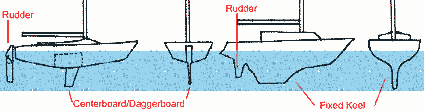
- The Rudder: The rudder of your boats is attached to either the steering wheel or the tiller. This is also located in the water and is like a fin at the back of your boat. The angle of the rudder determines in what way the boat is going to move. When the rudder is moved in one direction, the force of the water flowing over it makes the boat turn.
- The Sails: The most obvious part of the sailboat are the sails themselves. Wind acting on the sails provides the force that allows your boat to move through the water. On a basic level wind will push a sail from behind to make the boat move forward. The act of sailing also involves knowing how to get a boat moving even when the wind is not behind the sail. That includes allowing your boat to move into the wind.
Understanding Wind Direction

One of the hardest things for beginners to understand when they try to learn to sail is the direction of the wind.
- For most new sailors there is something called a No-Go Zone that you need to be aware of. This is where you will be unable to sail. That’s because of the direction of the wind not working with the position of your boat.
- You will only be able to sail when you are 45 degrees off the wind on either side of the direction that the wind blows.
Of course this doesn’t mean you are dead in the water if the wind isn’t blowing the way you want it to. But it does mean you’re going to have to learn how to tack.
- Tacking a boat means turning the bow through the wind so that the wind changes from one side of the boat to the other. This maneuver allows you to adjust how you’re sailing to catch the wind again.
Wind Directions and Tack
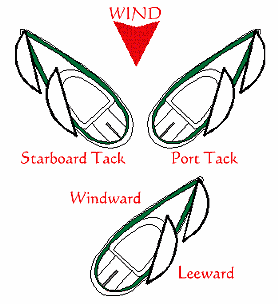
- Port Tack: This is what you call it when the wind is coming from the port side, or left side, of your boat. Remember, left and right are always based on you facing the bow, or front, of the boat. Always face front when referring to direction.
- Starboard Tack: Opposed to the port tack, this is when the wind is coming from the starboard, or right, side of the boat.
- Leeward: Sometimes called downwind, this is sailing on a course away from the wind.
- Windward: This is the opposite of leeward and refers to the way in which the wind is currently blowing. Since most sailing is done with the wind, windward is a direction that you will use more than the others. This is also referred to as upwind.
Points of Sail
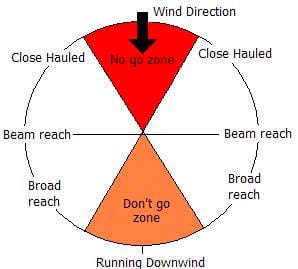
The term points of sail refers to the different angles that your sails can be at. Points of sail are important to understand in order to learn how to sail on the path you wish to go. They are the difference between how the wind blows and the course on which your boat is going to head. If you divide the open water into a circle, there are six points of sail that you need to know. Your location in the circle determines the points of sail you need to use.
- The No-Go Zone: As we mentioned previously, this is a 90-degree area that is too close to the wind to allow you to sail. You could sail on either side of this zone by learning how to tack your boat properly. Sailing directly into the wind puts you in the No-Go Zone. There will be no air in your sails and all movement stops. Good sailing skills can get your out of the No-Go Zone.
- Upwind Sailing: This includes two points of sail called close reaching and close-hauled. This is when you sail towards the path of the wind. Close-hauled is as close to the wind as you can get, just off the No-Go Zone. Your sails will have to be trimmed tightly for this to work. This is a difficult point-of-sail to master. If you overcompensate slightly, you will veer into the No-Go Zone again.
- Downwind Sailing: Just like upwind sailing, this includes two points of sail. They are broad-reaching and running. Broad reaching is when you are not directly downwind but at a broad angle off of the wind. Your sails will be let out slightly. Running is when you are sailing directly downwind. Your sails will be let out to either side of the boat. This can be difficult to master because judging the strength of the wind in your sails is not always easy. You need a good feel for the wind and soil skills to do this.
- Beam Reaching: This is the final point of sail, and it is when you are sailing across the wind. The wind can be coming from either the port tack or the starboard tack. This is considered the fastest point of sail. It is the easiest to master when you learn how to sail. This is the best method to keep wind in your sails.
Meeting Other Sailboats in the Water
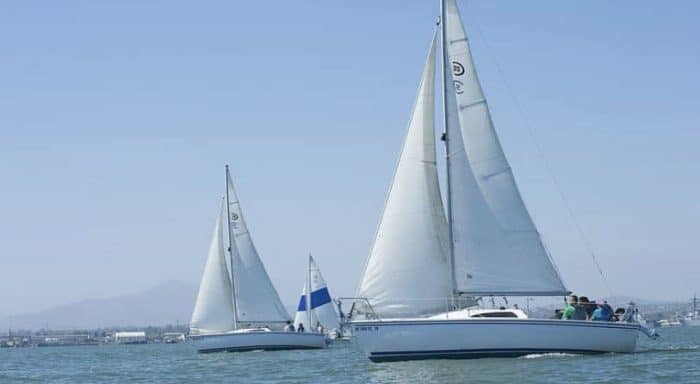
Understanding what tack you’re on is important for how you relate to other boats when you learn how to sail. On the road, it’s easier to know which car has the right of way. In the water, you have to keep some other things in mind. You need to figure out which boat is the give-way vessel, and which is the stand-on vessel. The give-way vessel must yield the right-of-way to the stand-on vessel. But how do you know which is which?
- If you and the other boats are on opposite tacks, the boat on the port tack will give way to the boat on the starboard tack.
- If both boats are on the same tack, the windward boat should avoid the leeward one. That means the boat that is farthest from where the wind is blowing has the right of way.
Are All Boats Treated the Same?
If you were in a liveaboard sailboat and the other vessel is a speed boat, then you should have the right of way. Keep in mind safety is the order of the day here. Using common sense always wins out over trying to strictly adhere to rules. If you have to give way to a boat that doesn’t have the right of way to avoid a collision, you should do so. Trust your eye over a rule book.
Three Basic Rules to Be a Successful Sailor

Rule 1: Handling Halyards
When handling halyards, make sure that:
- both ends of the halyard are in your hands
- one end is securely attached and the other is in your hand
- both ends are securely attached to something
Why, you ask? So one end of the halyard doesn’t fly to the top of the mast causing the skipper to ask you to do the same and bring it back down.
Rule 2: Working with winch handles
- the handle is in your hand
- the handle is in the winch and in your hand
- the handle is stowed in its proper safe location
Why, you ask? A winch handle left unattended in a winch or on deck can suddenly be lurched overboard by a sudden wave or a slip of the foot. Speaking of lurching overboard, it is usually the skipper’s command to the one committing the violation as he explains that those cost $75.00 as you hit the water.
Rule 3: Sailing On a Beautiful Day
- you don’t try to sail where the birds are standing
- you don’t try to sail where the birds are standing
- you don’t try to sail where the birds are standing
Why, you ask? Guess!
Things to Remember
Sailing can be a lot of fun. It’s a great to relax, and bond with friends and family. But doing it safely and responsibly is of the utmost importance. You need to understand the correct terms and what to do when something goes wrong. There is a lot of stuff to know, but don’t feel discouraged. Becoming a sailor is by no means impossible. You can learn how to sail by approaching it in a smart way from the beginning.
Master Sailing Terms
- The language of sailing is one of the most difficult things to master. Understanding a few of the basics of the language like port side is one thing. But you should know what people mean when they talk about a keelboat, mainsail, or sail trim, for example.
- Do you know the difference between mooring and dry docking it? What’s a mainsail and a spinnaker? This may be old hat to an experienced sailor. But for a new sailor, all of these needs to be fully understood. If you want to be a part of a sailing club, you’ll definitely need to know the sailing terms. When you learn to sail, you’ll obviously be confronting them frequently.
- Don’t let sailing words overwhelm you. There are probably plenty of sailors out there right now who don’t recall the right word from time to time. Just do your best and learn the basics. If you forget a few, look them up later. You don’t need to reach the top levels of sailing right away. No person is an expert right from the beginning.
Learn Sailing Skills
- Reading about sailing is important to prepare yourself for getting out on the open sea and in the open air. But the value of sailing lessons should not be underestimated. Just like driving a car, it’s best to be shown what to do and get some practice before you head out sailing on your own.
- There are sailing schools all over the United States that can show you what you need to know. Hands-on learning is often a more clear method of preparing yourself. If you’re serious about sailing, do yourself a favor and take a sailing course.
- Research local sailing schools. Find the one that’s going to provide the best information at the best price for you. Before you leave the dry dock, make sure you know what you’re doing. The more prepared, the better. Plus, if you have a question, a teacher can offer a precise answer.
Quick Tips To Keep in Mind
There are a few tips and tricks that you can keep in mind. These aren’t strictly speaking things you’ll find in a book on professional sailing techniques, but they can definitely help you.
Always at Your Fingertips
- Keep a nail polish bottle (complete with brush) full of your favorite varnish. It will come in handy to cover scratches, dents, etc. prior to the wood discoloring.
Twinkle Twinkle Little Star
- For a quick evaluation of a nighttime crossing situation, note the position of the vessel being observed in relation to a star.
- If the star and the vessel remain in the same relative position for several minutes, that signals that a constant bearing exists and you should start to make plans accordingly.
Rubber Boots
- Have a leaking mast boot? Replace it with a waterproof and inexpensive repair. Wrap an ace bandage tightly around the bottom of the mast.
- Find that can of Dip Whip that you have been putting off using to whip the ends of all those frayed lines.
- Paint three coats of Dip Whip over the ace bandage. The result is a flexible, waterproof repair that will last for seasons of use.
Watch Out for Mud Flats
- If you do get stuck, beware of local sea life which you may not be accustomed to like the Portuguese Man-of-war or Stingray.
- Make sure your VHF is working BEFORE you leave shore. Notify someone of your sailing plans for the day and when you plan on returning.
- Bring an appropriate amount of food and water (non-salted variety) for a long day out as the local conditions may get bad (really windy) or worse (no wind).
- If you ground out and decide to push the boat off, the bottom you are about to step in may be very soft. You may get stuck as your boat decides to sail away.
Have Fun
There’s an old expression that says ‘ this ain’t no day at the beach.’ It’s meant to refer to something that isn’t easy. But sailing really can be a day at the beach. It is meant to be a leisure time activity. It was the kind of thing you can enjoy all over the world. Once you have mastered the knowledge you need, then you can enjoy the rewards of the lifestyle. And that should be the same for any activity.

Categories: Boats, nauticalknowhow